
Investing in Existing Rental Property in 2026: the Guide to Succeed Remotely
Buying an older property in France to rent out remains, in 2026, one of the most solid wealth-building strategies for an expat. More accessible entry prices than new-builds, central locations, powerful tax advantages: on paper, the case is compelling. In practice, profitability depends on three very concrete factors — location, the cost estimate for the works, and the taxation applicable to your non-resident status.
This guide is designed for a French expat managing everything remotely. It covers what the "generic" guides leave out: what really changes in the taxation of existing property when you are not a French tax resident, how to estimate a renovation budget without being able to visit, and how to finance the deal without getting stuck on the deposit. For the overall financing framework, keep our mortgage guide for expats open alongside this one.
Existing Property in 2026: what the market is saying
The existing-property market returned to growth in 2025 after two years of correction. Transactions climbed back to around 900,000 sales for the year according to the Notaires de France figures, compared with a low point of 800,000 in 2024. Interest rates have fallen back into the 3.05%–3.40% range over 20-25 years, and combined with prices that remain below their highs in most major cities, they are opening a fairly favorable buying window.
For an expat, existing property offers three structural advantages compared with new-builds:
Location: existing property is found in city centers and historic districts. New-builds are almost always on the outskirts.
Price per sqm: the gap commonly ranges from 15% to 30% in favor of existing property, for the same surface area.
Gross rental yield: renovated existing property typically runs between 4.5% and 6% depending on the city, versus 3% to 4% for "Pinel law" new-builds.
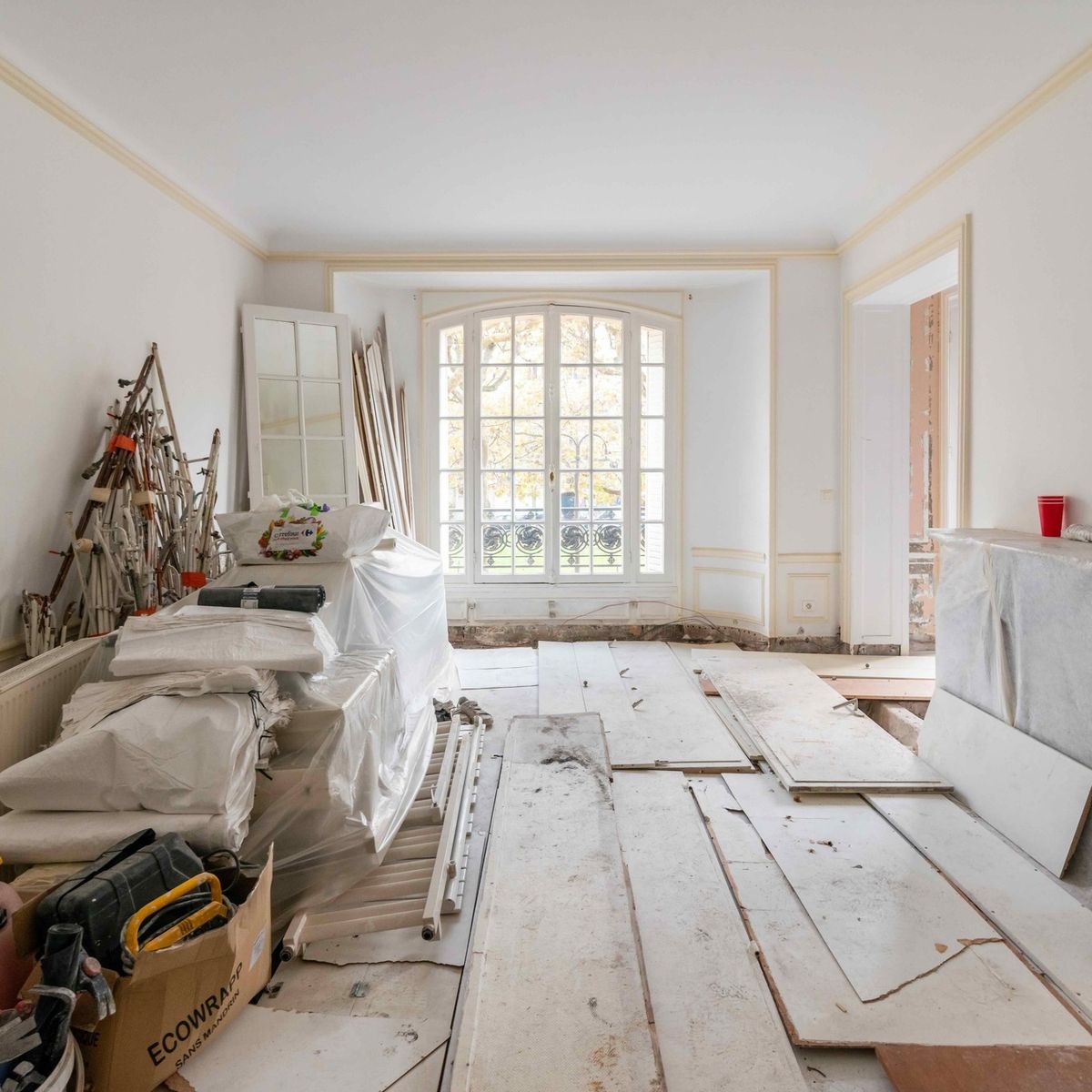
In return, existing property involves works (energy rating, compliance upgrades, sometimes an older condominium building). This is exactly where profitability — and taxation — are decided. For a detailed comparison, see our article new-build vs existing property for an expat investor.
💡 Key takeaway: existing property is a "value-creation" product. You buy at a discount, renovate, rent at a higher price, and increase the value of the property when you sell. That lever does not exist in new-builds.
Taxation of existing property: what changes for a non-resident
This is the chapter that every standard guide gets wrong. The famous tax mechanisms used in older-property investing — property income deficit, LMNP, Denormandie — work differently depending on whether you are a French tax resident or not. Here is the real trade-off for an expat.
Unfurnished rental and property income deficit
In an unfurnished rental, your rent is taxed as property income. Two regimes:
Micro-property-income regime: flat 30% allowance on gross rent, simple, capped at €15,000 of rent per year.
Actual-expense regime: deduction of actual expenses (mortgage interest, works, property tax, management fees, non-occupier insurance, etc.). Mandatory above the threshold, and almost always more advantageous as soon as there are works.
A property income deficit arises when your deductible expenses exceed your rent. For a resident, this deficit is offset:
up to €10,700/year against total income (including salaries),
with any excess carried forward for 10 years against property income only.
⚠️ Non-resident warning: offsetting €10,700 against total income is very rarely useful for you. You generally do not have total taxable income in France to offset — your salary is taxed in your country of residence. The property income deficit only helps you erase your other French property income, current and future (over 10 years). That is useful, but far less powerful than for a resident.
Furnished rental (LMNP): the real lever for an expat
The Non-Professional Furnished Rental (LMNP) status turns your rent into BIC (Industrial and Commercial Profits) and opens up accounting depreciation of the property and furniture. In practical terms, you deduct each year a portion of the value of the building (excluding land) from your rental income.
For a non-resident, this is the most effective option in the majority of cases:
Depreciation typically neutralizes the taxation of rent for 10 to 15 years.
The mechanism works the same way for a non-resident as for a resident — it wipes out your French BIC income, source by source.
Rents are higher in furnished rentals (a 10% to 20% premium depending on the city).
The downside: LMNP accounting is more demanding (a specialized accountant costs €600 to €1,200/year).
Denormandie existing property: available to non-residents, under conditions
The Denormandie scheme (extended until December 31, 2027) gives you a tax reduction spread over 6, 9, or 12 years, capped at 21% of the acquisition price over 12 years (i.e. up to €63,000 for a €300,000 investment). The conditions are:
the property must be in an eligible municipality (about 245 medium-sized towns under the "Action Cœur de Ville" program),
works representing at least 25% of the total project cost,
a rental commitment at a capped rent and subject to tenant income conditions.
⚠️ Non-resident warning: the Denormandie tax reduction is offset against the French tax due. A non-resident is taxed in France at a minimum rate of 20% on property income — so the reduction can be used, but only up to the amount of your annual French tax. Run the numbers with a tax specialist before you commit.
Summary table: resident vs non-resident
Mechanism | FR tax resident | Non-resident |
|---|---|---|
Micro-property-income regime (30% allowance) | ✓ available | ✓ available |
Actual-expense regime + expense deduction | ✓ fully useful | ✓ useful |
Property income deficit against total income (€10,700) | ✓ immediate effect | ❌ useless in practice |
Property income deficit carried forward for 10 years | ✓ | ✓ |
LMNP + depreciation | ✓ | ✓ (often the best option) |
Denormandie existing property | ✓ | ✓ within the limit of French tax due |
Minimum tax rate on property income | progressive tax bracket | 20% minimum (30% above €29,015) |
Social contributions (17.2%) | due | ✓ exempt for EU/EEA/Swiss residents; non-EU = 7.5% solidarity levy |
For the details of non-resident taxation, see our guide to taxation of property income for non-residents.
💡 Key takeaway: for an expat, the tax trade-off for existing property does not look like that of a resident. LMNP is almost always the right move. The actual-expense regime in an unfurnished rental still makes sense if you have major works and other French property income to offset over 10 years.
How to source the right property remotely
The success of an existing-property investment depends first and foremost on sourcing. Remotely, you cannot multiply visits — so you need to structure the search to eliminate quickly anything that does not stand up.
Three location filters to apply up front
Rental demand pressure: the supply/demand ratio for rentals. Sites such as Locservice or Castorus provide a decent proxy. A city where a one-bedroom apartment is rented in less than 15 days is a favorable signal.
Five-year neighborhood outlook: urban projects (new transport lines, urban regeneration, university expansions), demographic trends. The local zoning plan (PLU) is a public, readable document.
Target tenant profile: students, young professionals, families. Each profile requires a specific type of property, a location, and an optimal tax regime (LMNP for students ≠ unfurnished rental for families).
Energy rating: a negotiation tool, not a deal breaker
A property rated F or G on the energy performance certificate is being progressively banned from the rental market (G since 2025, F planned for 2028, E in 2034). Many investors walk away — and that is exactly what creates the opportunity.
Purchase discount: an F/G energy rating is commonly negotiated 5% to 15% below an equivalent D-rated property.
Energy renovation: insulation plus heating upgrades can bring it up to C or D with a manageable budget (€10,000 to €30,000 for an apartment).
Bonus: energy-improvement works are fully deductible under the actual-expense regime and may open access to subsidies such as MaPrimeRénov' (subject to residency conditions — check case by case).
⚠️ Warning: before buying an F- or G-rated property, require an energy audit (mandatory at sale since 2023) that precisely estimates the works needed to improve the energy rating. This is the document you use as the basis for negotiation.
Works checklist: 4 items to estimate separately
When you receive a report from a property hunter or project manager, insist on a breakdown into four lines — that is what determines the total cost and the risk.
Structural (roof, framework, load-bearing walls, foundations). This is the deal-breaker: if there is any doubt here, walk away.
Systems (electricity, plumbing, heating). Costly but predictable items, often €200 to €400/sqm.
Insulation and joinery (windows, wall/attic insulation). The energy-rating lever. €100 to €250/sqm for a gain of 1 to 2 rating levels.
Aesthetic (floors, paint, kitchen, bathroom). The most visible for the tenant, and the easiest to control. €200 to €500/sqm.
✅ Good to know: plan a 10% to 15% safety margin on the renovation budget. In existing property, surprises are not the exception — they are the norm.
Gross vs net return: the real number
The gross return shown in listings is only useful for filtering. To decide whether to buy, what matters is the net return — the one that includes all recurring charges and rental vacancies.
The costs you should always include
Property tax: very variable depending on the municipality. Ask the seller for the latest bill.
Property management fees: 6% to 9% of gross rent in traditional management, more for specialized digital agencies focused on expats (up to 12%, but with a more complete service).
Non-recoverable condominium charges: management fees, major works, façade renovation. Read the last three homeowners' association meeting minutes before signing.
Non-occupier insurance (PNO): mandatory for condominium properties since the ALUR law. Around €150/year for a standard apartment.
Reserve for works and vacancy: set aside 1 to 2 months of rent per year. Non-negotiable for an expat — you cannot afford a broken boiler without cash available.
Worked example: existing one-bedroom apartment at €150,000
Assumption: a 40 sqm one-bedroom apartment bought for €150,000 (fees included), rented for €700/month after renovation.
Item | Annual amount |
|---|---|
Gross rent (€700 × 12) | + €8,400 |
Property tax | – €900 |
Property management fees (8%) | – €672 |
Non-recoverable condominium charges | – €600 |
PNO insurance | – €150 |
Works / vacancy reserve (2 months) | – €1,400 |
Total charges | – €3,722 |
Annual net income | + €4,678 |
Gross return: 8,400 / 150,000 = 5.6% Net return before tax: 4,678 / 150,000 = 3.1%
For an expat under the actual-expense regime and non-resident status, tax comes next: minimum 20% on net property income (or neutralized through depreciation in LMNP). The net-net return "in your pocket" typically ends up between 2.2% and 3% depending on the tax regime chosen, compared with almost no net return at all on standard new-build rentals.
💡 Key takeaway: a one-bedroom apartment in an existing building in a secondary major city (Rennes, Montpellier, Nantes…) remains one of the few products that can generate positive cash flow after mortgage, charges, and taxes for an expat. That is rarely the case in the Paris region.
Financing an existing-property project from abroad
Financing an existing property from abroad combines two constraints: the usual non-resident requirements + financing the works. Here are the rules of the game.
Deposit: 20-30% directly, 10-20% via a specialized broker
French banks usually require 20% to 30% down payment from a non-resident, based on the total cost (purchase price + notary fees + works). Through Invexa's network of banking partners, that threshold drops to 10% to 20% in most cases.
The deposit must at minimum cover the notary fees (7% to 8% in existing property), which are often paid separately from the mortgage financing.
Weighting foreign-currency income
A bank financing in euros and seeing income in USD, GBP, or CHF applies a currency haircut to calculate your borrowing capacity:
Stable currencies (CHF, USD, GBP): a 10% to 20% haircut.
More volatile currencies: it can rise to 30% to 40%.
This weighting directly limits your borrowing envelope. A broker who knows each bank's scoring grid can direct your file to the lender where the haircut is lowest. Details in our expatriate mortgage guide.
Financing the works within the main mortgage
Strategic for existing property: include the cost of the works in the mortgage rather than paying cash for them. Three advantages:
You keep your savings as a safety cushion.
The interest on the works mortgage is deductible from property income (actual-expense regime).
You activate mortgage leverage on the value created after the works.
Not every bank accepts financing the works within the same package — this is typically the kind of point the broker negotiates during the structuring stage.
Borrower insurance and purchase structure
Two decisions to make early:
Borrower insurance: delegating to an external insurer is almost always more advantageous for an expat than the bank's group policy. See our expat borrower insurance guide.
In your own name or SCI: buying in your own name is simple and sufficient for a first solo investment. An SCI becomes relevant for a joint purchase, an estate-planning strategy, or a larger asset base. Details in our SCI guide for expats.
Managing renovation and rental operations remotely
A remote existing-property project is built around two parallel workstreams: the initial renovation and the long-term rental management. Outsourcing both properly is non-negotiable.
During the works
Independent project manager or architect paid by percentage (8% to 12% of the works budget). They estimate the cost, select the trades, oversee the site, and approve staged payments.
Weekly video call + daily photos. Standard practice for a serious expat renovation.
Progress payments validated against actual work completed (never 100% at order, except for prefabricated kitchens/bathrooms).
Once rented out
Two rental-management models coexist:
Traditional local agency: 6% to 9% of rent, with physical presence on site.
Expat-specialized digital agency (Manda, Flatlooker, Imodirect): 4% to 8%, online interface, asynchronous communication — often better suited to time-zone differences.
To compare the two models in detail: property management guide for expats. If you want to delegate the entire chain (search, renovation, letting, management), also look at our turnkey rental investment dossier.
✅ Good to know: arrange a notarized power of attorney from your country of residence (consulate or local notary with apostille) before the preliminary agreement. That way, you avoid having to travel back for the signing of the final deed.
Mistakes to avoid
Four recurring mistakes destroy the profitability of a remote existing-property project:
Underestimating the works. Mistake #1. Always get a professional estimate before the preliminary agreement, never rely on an agency estimate.
Choosing the wrong tax regime. Defaulting to micro-property income when LMNP or the actual-expense regime would be far more effective. This decision must be made before buying, not after.
Ignoring the energy rating. A property rated F or G bought without an energy audit and without a renovation plan becomes unsellable and invisible on the rental market.
Buying without a rental-demand study. The nicest renovated property is useless if there is no rental demand for it.
For the full list of classic expat-investing traps, see our 10 fatal mistakes to avoid.
Conclusion
Investing in existing rental property remains, in 2026, one of the best vehicles for a French expat who wants to build wealth in the euro area. Market conditions are favorable, the tax levers work (differently depending on your status, but they do work), and remote management is now a solved problem.
Three points of vigilance for an expat:
Choose the right tax regime before buying — for a non-resident, LMNP is almost always the right move.
Have the works properly estimated and keep a 10% to 15% margin.
Structure the financing with a broker who knows the non-resident grids — that is what can bring the required deposit down from 30% to 15%.
At Invexa, we support expats every day on exactly this type of project, from feasibility analysis through to signing with the notary. If you want to see what your file looks like, the initial analysis is free.
Table of Contents