How to Buy Property in France: Your 2026 Guide
Discover how to buy property in France as a non-resident. Our 2026 guide covers eligibility, financing, legal steps, & avoiding costly mistakes.
published
Outrank AI
how to buy property in france, french real estate, non-resident mortgage france, buy house in france, france property investment
359a6f76-ceda-493c-af4c-454cea9e57d7

You're probably starting where most non-resident buyers start. A tab open with Paris apartments, another with village houses in Provence, a saved search you check too often, and a quiet worry in the background that the purchase process may be much harder than the dream itself.
That worry is reasonable. Buying in France is not usually blocked by nationality. What catches expatriates out is everything around the property: foreign income that a French bank struggles to read, documents spread across countries and languages, borrower insurance, timing with the notaire, and legal choices that are expensive to correct later.
I see the same pattern often. A buyer finds the right home first and only then asks whether their salary in dollars, pounds, dirhams, or mixed company income will be accepted by a French lender. Another signs too quickly without understanding what the diagnostics say. Another assumes joint purchase is automatically the right structure, when inheritance or family planning would have pointed elsewhere.
If you want to understand how to buy property in France without getting lost in generic checklists, focus on the part that decides whether the project closes: preparation, financing, and structure. The legal steps matter. But for expats, they are only one part of the deal.
The Dream of French Property vs The Reality for Expats
The dream is easy to picture because France sells itself well. A compact apartment with tall windows in Paris. A stone house with shutters and plane trees in the South West. A family base for holidays now, maybe longer stays later.
Often, the circumstances arrive in a different form. It sounds like this: “My income is in another currency.” “I'm self-employed.” “The bank asked for documents I've never had to produce before.” “I don't understand who protects me, the estate agent or the notaire.” “Can I even do this remotely?”
Those are the right questions.
For most foreign buyers, the purchase doesn't fail because France forbids it. It fails because the project wasn't organized in the order French lenders and notaires expect. The buyer starts with emotion, while the system starts with evidence. It wants a coherent file, clean source of funds, understandable income, realistic timing, and a clear ownership plan.
Buying in France from abroad is rarely a legal impossibility. It's a coordination problem.
That's why the usual articles can feel incomplete. They explain the names of the documents but not what tends to break under real pressure. A non-resident deal can stall because the mortgage file wasn't prepared early enough. It can get more expensive because the buyer budgeted for the price but not the acquisition costs. It can become awkward years later because the wrong ownership format was chosen at the start.
The good news is that these problems are manageable when handled in the right sequence. You don't need to know every legal detail before you begin. You do need to know what deserves attention first, what can wait, and where specialist help changes the outcome.
Laying the Groundwork Your Pre-Purchase Checklist
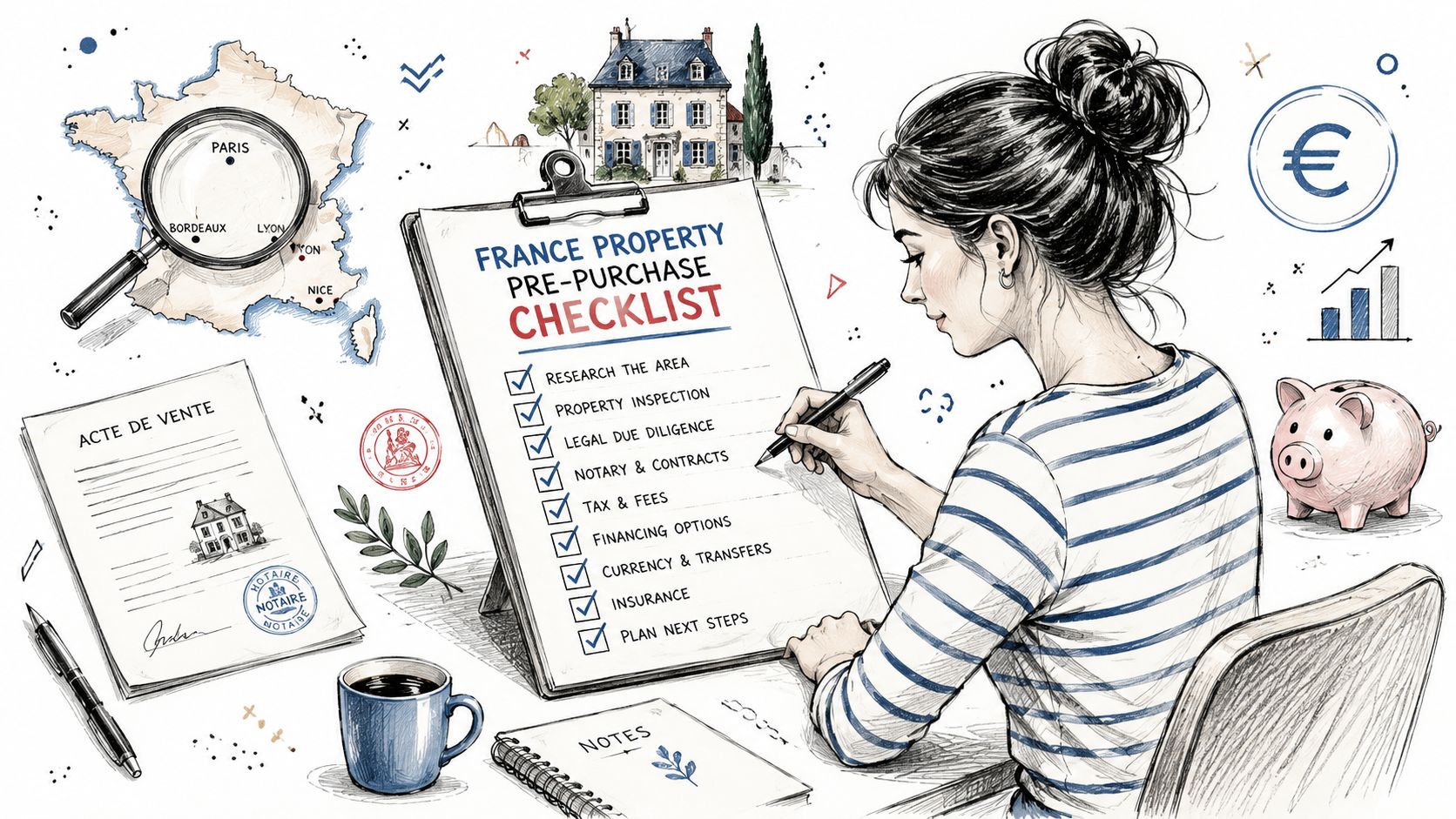
Before you book viewings, get three things straight: why you're buying, what you can really afford, and how clean your paperwork is. Buyers who do this first move faster later. Buyers who skip it usually spend weeks correcting preventable issues.
Define the project before the search
A French property can be a home, a second residence, a rental asset, or a mix of all three. That choice affects financing, ownership structure, and even the kind of property that makes sense.
Ask yourself:
Personal use first: Will you use it mainly for holidays, future relocation, or family stays?
Income first: Do you expect regular rental use, occasional rental use, or none at all?
Exit plan: Is this a long-hold family asset, or something you may sell if life changes?
These answers matter more than buyers expect. A lender reads a primary residence project differently from a second-home project. A family purchase raises different questions from a solo investment purchase.
Build a budget that survives reality
France is open to foreign buyers, but the transaction timeline and money flow need planning. A standard purchase is typically two to four months from the preliminary contract to final signing, with a 5% to 10% deposit held by the notaire while legal checks and financing are completed, according to this overview of buying property in France for foreign buyers.
That means your budget can't stop at the asking price. You need room for the deposit, acquisition costs, bank-related costs if you finance, and a margin for practical friction such as document updates or transfer timing.
A simple pre-flight checklist looks like this:
Purchase price ceiling: Set the maximum number you're comfortable with, not the number an estate listing tempts you with.
Cash available early: Make sure the deposit funds are liquid and traceable.
Closing cost cushion: Keep part of your funds untouched for fees and last-minute adjustments.
Post-completion reserve: Leave breathing room for the first works, furnishing, or ownership setup costs.
Practical rule: If your budget only works on paper and leaves no flexibility, it's too tight for a cross-border purchase.
Treat documents as part of the deal
Nationality is rarely the problem. Documentation is.
French lenders and notaires want clarity. If your income comes from several countries, if your company accounts are in one language and your tax returns in another, or if your civil-status documents don't align cleanly, solve that early. For buyers who need help turning French paperwork into usable English, or vice versa, a practical resource is this guide to translating French documents.
Prepare a working file with:
Identity documents: passport, proof of address, civil status documents where relevant
Income evidence: employment contracts, payslips, tax returns, company accounts, dividend evidence, bank statements
Asset evidence: savings, investments, existing property holdings, outstanding loans
Source of funds support: especially if part of the deposit comes from asset sales, gifts, or company distributions
Know what “ready” really means
Being ready doesn't mean you've chosen the property. It means that once you find it, you can act without improvising. The strongest buyers already know how much equity they can deploy, what their bank profile looks like, and which documents may need translation or explanation.
That preparation is what makes the rest of the purchase feel controlled instead of chaotic.
Cracking the Code of Non-Resident Mortgages in France
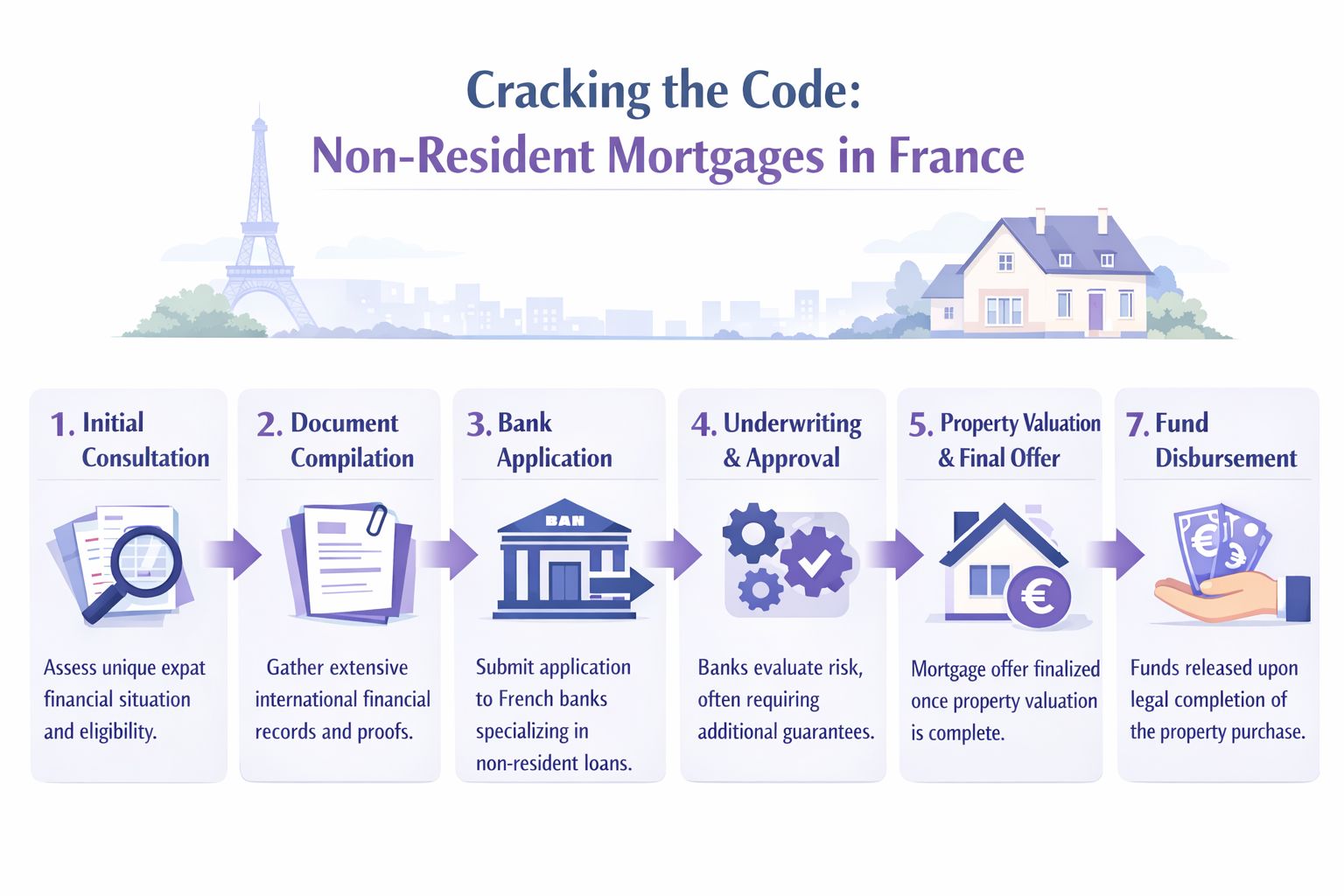
The hardest part of how to buy property in France as an expat is usually not the property. It's the mortgage file.
French banks are methodical. They don't like ambiguity, and foreign income creates ambiguity fast. A salary paid outside France, a bonus-heavy package, freelance income, dividends, retained company profits, or earnings in another currency can all look less straightforward to an underwriter than a domestic salaried file.
Why banks hesitate
The core constraint is simple. French lenders work with a strict 35% debt service cap, and non-resident files often become difficult because banks don't always weight foreign income cleanly. In a rate-sensitive market, application structure can determine approval or rejection, as explained in this guide to buying property in France for non-residents.
The underwriting problem is not just “how much do you earn?” It's also:
Issue | What the bank worries about |
|---|---|
Foreign currency income | Exchange-rate movement and income stability |
Self-employment | Irregular earnings and documentation quality |
International tax profile | Whether declared income is easy to verify |
Existing debts abroad | Full debt-service picture across countries |
Complex assets | Which assets are liquid and acceptable |
A buyer may be wealthy and still present a difficult file. That's common. Strong income does not automatically mean underwriter-friendly income.
What works and what doesn't
What doesn't work is sending a French bank a pile of raw documents and hoping the story explains itself. That approach often creates questions instead of confidence.
What works is turning your profile into a file a French underwriter can read quickly:
Income must be categorized clearly: salary, dividends, rental income, business income, or asset-based support
Currency exposure must be explained: especially when liabilities and income sit in different currencies
Existing commitments must be mapped: not hidden or loosely described
The project must make sense: property type, use, contribution, and timeline should align
A mortgage file isn't just paperwork. It's an argument. If the argument is unclear, the bank defaults to caution.
A specialist broker changes the process. The broker's job is not only to forward your application. It's to shape it. That means identifying which bank is more comfortable with your type of income, what presentation will survive underwriting, and when to launch the file relative to the purchase calendar.
For a detailed breakdown of the financing path, this French mortgage guide for expatriates is a useful companion.
Timing matters as much as eligibility
Too many buyers wait until after the preliminary contract to think seriously about financing. That's risky. Mortgage approval can take time, and foreign-document requests can add more delay when a file is not prepared properly from the beginning.
Borrower insurance also matters more than many expats expect. It can be straightforward for one borrower and complicated for another, especially if work location, residency, or medical disclosure creates extra questions. If insurance drags, the whole mortgage drags.
A specialist broker such as Invexa works on this exact problem set: non-resident income analysis, bank selection, borrower insurance coordination, and remote support through to notary signing. That doesn't replace the notaire or tax adviser. It fills the financing gap that general property guidance often leaves open.
The real objective
Your objective isn't merely to “get a mortgage.” It's to secure financing that fits the property, your residency status, your documentation reality, and your long-term plans.
That often means asking better questions early:
Should you buy now or wait until your income profile is easier to present?
Is personal borrowing cleaner than buying through a structure?
Will one borrower weaken or strengthen the file?
Is the deposit level appropriate for the banks most likely to consider you?
These are practical questions, not theoretical ones. They decide whether a French property dream becomes a signed deed or another abandoned search alert.
Navigating the French Property Purchase Timeline
You agree a price on a house in France, transfer a deposit, then the estate agent asks for signatures, the notaire requests documents, and the bank starts asking questions in French legal terms you have never had to deal with before. For non-resident buyers, this is usually the point where anxiety rises. The process is orderly, but only if you understand what happens when, what can still go wrong, and where financing can slow the file.
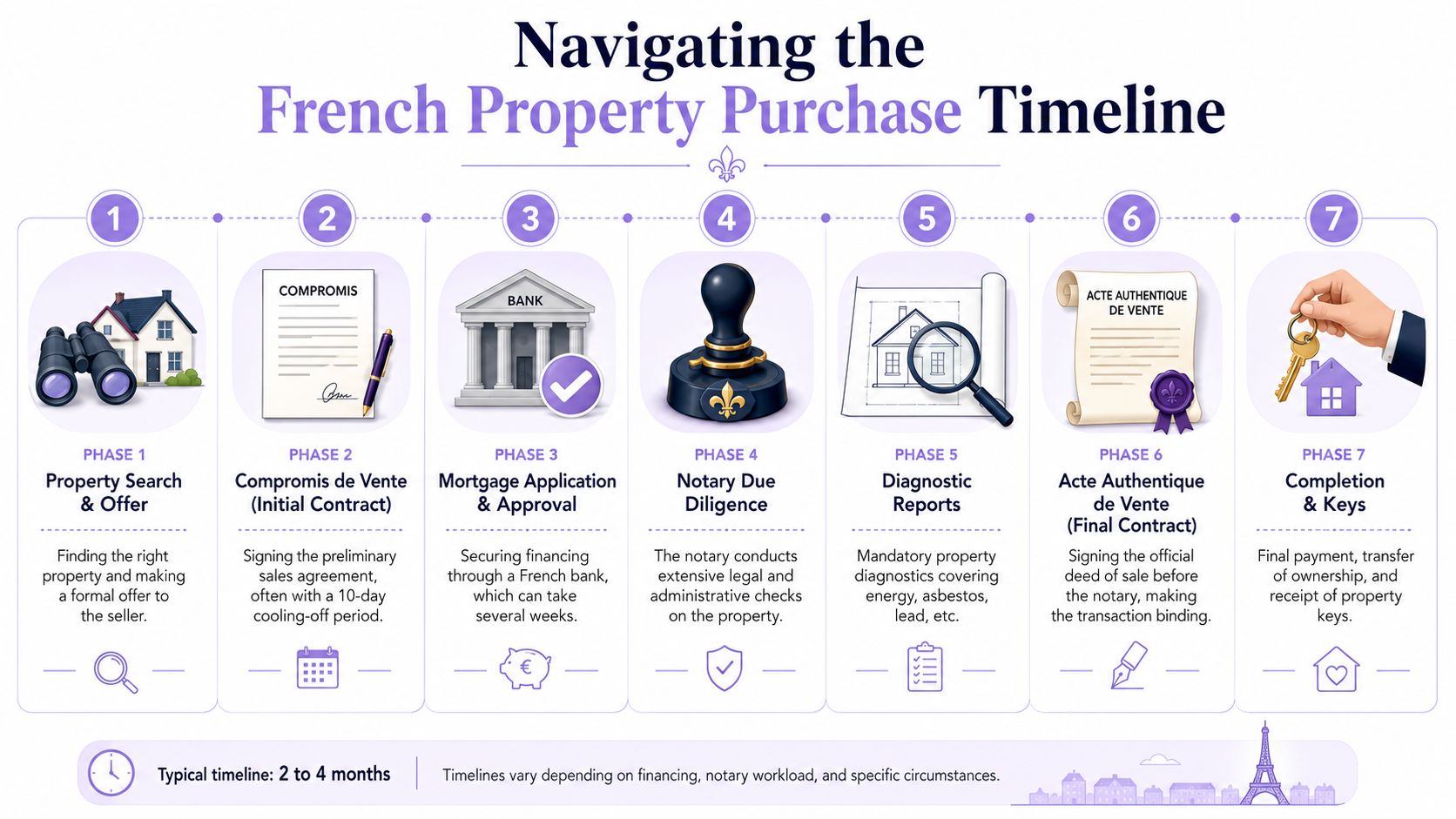
From accepted offer to compromis de vente
An accepted offer is the commercial starting point. The first real legal milestone is the compromis de vente or, in some cases, a promesse de vente.
Many expat buyers treat the accepted offer as if everything is already secured, but it is not. Proper inclusion of the financing timetable, deposit arrangements, and legal conditions into the preliminary contract is essential. If your income comes from abroad, if you are buying remotely, or if the mortgage file is still being assembled, the wording and deadlines require careful attention.
At this stage, expect a few core points:
The preliminary contract creates legal commitments.
The buyer benefits from a 10-day cooling-off period after notification of the signed contract.
A deposit is usually requested, often in the range of 5% to 10%, depending on the file and negotiation.
Purchase costs for older properties are higher than many foreign buyers expect, because notaire fees and taxes must be added to the price.
The notaire is responsible for the legal transfer. The estate agent manages the transaction flow. Your broker or lender handles the mortgage side. Problems start when buyers assume one professional is covering all three.
The period between contract and completion
This is usually the least visible part of the purchase, and the one that unsettles overseas buyers most.
After the preliminary contract, the notaire carries out searches and prepares the deed file. If you need a mortgage, the bank reviews the application, checks documents, issues a formal offer, and waits through the legal acceptance period. If anything in your file is unclear, foreign income, bonus structure, company accounts, tax residency, source of deposit, borrower insurance, the transaction can lose time quickly.
Silence during this period is normal. Delay without explanation is not.
In practice, this middle phase is where a specialist broker often earns their place. A non-resident mortgage file rarely moves in a straight line. Banks may ask for translated documents, updated payslips, proof of tax paid abroad, or a clearer explanation of how the property will be used. A weak file here does not only delay financing. It can put pressure on contractual deadlines already agreed in the compromis.
The seller also provides the property's diagnostic reports. These reports are required disclosures, not a substitute for an independent survey or building opinion. For older village houses, rural properties, or anything with visible renovation history, that distinction matters.
For a broader view of the mistakes that tend to derail overseas purchases, see Invexa's tips for French property investment.
Final deed and key handover
The last signing is the acte authentique, also called the acte de vente. This is the document that transfers ownership.
In a standard transaction, buyers often complete a few months after the preliminary contract, but the timetable depends on the notaire's checks, whether finance is involved, how quickly documents are produced, and whether any title or planning issue appears during the file review. Cash buyers can sometimes move faster. Non-resident borrowers often need more margin, not less.
Remote signing is possible in some cases, but do not assume every notaire will handle it the same way. Confirm early how powers of attorney will be arranged, when funds must arrive, and which account the deposit and final balance must be sent to. I have seen completions delayed for reasons as simple as late international transfers or an unsigned power of attorney sitting in the wrong inbox.
A practical summary looks like this:
Stage | What it means |
|---|---|
Offer accepted | Price agreed, subject to contract and checks |
Compromis de vente or promesse | Preliminary legal commitment |
Cooling-off period | Buyer cancellation window after notification |
Notaire and lender review | Legal checks, mortgage processing, document follow-up |
Acte de vente | Final deed is signed |
Keys handed over | Ownership and possession pass to the buyer |
For non-residents, the timeline is not difficult because the French terms are unfamiliar. It becomes difficult when financing, legal drafting, and document collection are not coordinated early enough. That is the point to watch.
Smart Ownership How to Structure Your French Property Purchase
A French purchase is not only about getting the property. It's also about choosing how you will own it. On this point, many non-residents move too quickly.
The usual options are simple in appearance: buy in your own name, buy jointly, or buy through an SCI. But the right answer depends on family goals, inheritance planning, co-borrowing, and how the property will be used. That's why ownership structure should be addressed early, not after the offer is accepted.
Buying personally or jointly
For a single buyer with a straightforward objective, personal ownership is often the cleanest route. It's easy to understand, usually easier to document, and can be simpler for financing.
Joint ownership can work well for couples or family members purchasing together, but it raises real questions:
Who contributes what?
What happens if one party wants to sell?
Does the ownership split reflect legal reality and family intention?
How should succession be thought through across jurisdictions?
These are not edge cases. They are standard non-resident concerns.
When an SCI enters the discussion
An SCI is a French property-holding company often used for family ownership and succession planning. It can be useful, but it is not a universal upgrade. In some situations it helps with long-term organization and transmission. In others, it adds administration and can complicate financing if introduced without a clear reason.
A practical way to compare the options:
Ownership route | Usually suits | Main caution |
|---|---|---|
Personal ownership | Solo buyers, simpler files | May be less flexible for family planning |
Joint ownership | Couples or co-buyers | Exit and inheritance issues need thought |
SCI | Family strategy, long-term structuring | Needs proper legal and tax guidance |
A deeper look at this route is available in this article on SCI pour expatriés en France.
The real trade-off
The key point is qualitative but important. Structure affects more than signatures on a deed. It can influence lender acceptance, succession outcomes, internal family control, and the cost of fixing mistakes later.
A structure should solve a real problem. If it only makes the purchase feel more sophisticated, it's probably the wrong reason to use it.
You also need to think beyond acquisition. Ownership creates ongoing obligations and future decisions. If one buyer is funding more than another, if a property may later be occupied by children or parents, or if a future resale could become sensitive, those issues should shape the structure from the start.
The common mistake is copying what another buyer did. The right structure is specific to your family, income profile, and objective. A holiday apartment for a couple, a legacy asset for children, and a mixed-use investment property do not need the same legal wrapper.
Common Pitfalls and How to Avoid Them
You find the right property, the offer is accepted, and for a few days it feels simple. Then pressure starts. The bank wants clearer evidence of foreign income. The notaire asks for documents you did not know you needed. The diagnostic file raises questions no one explained properly. That is usually where stress enters a French purchase for non-residents.
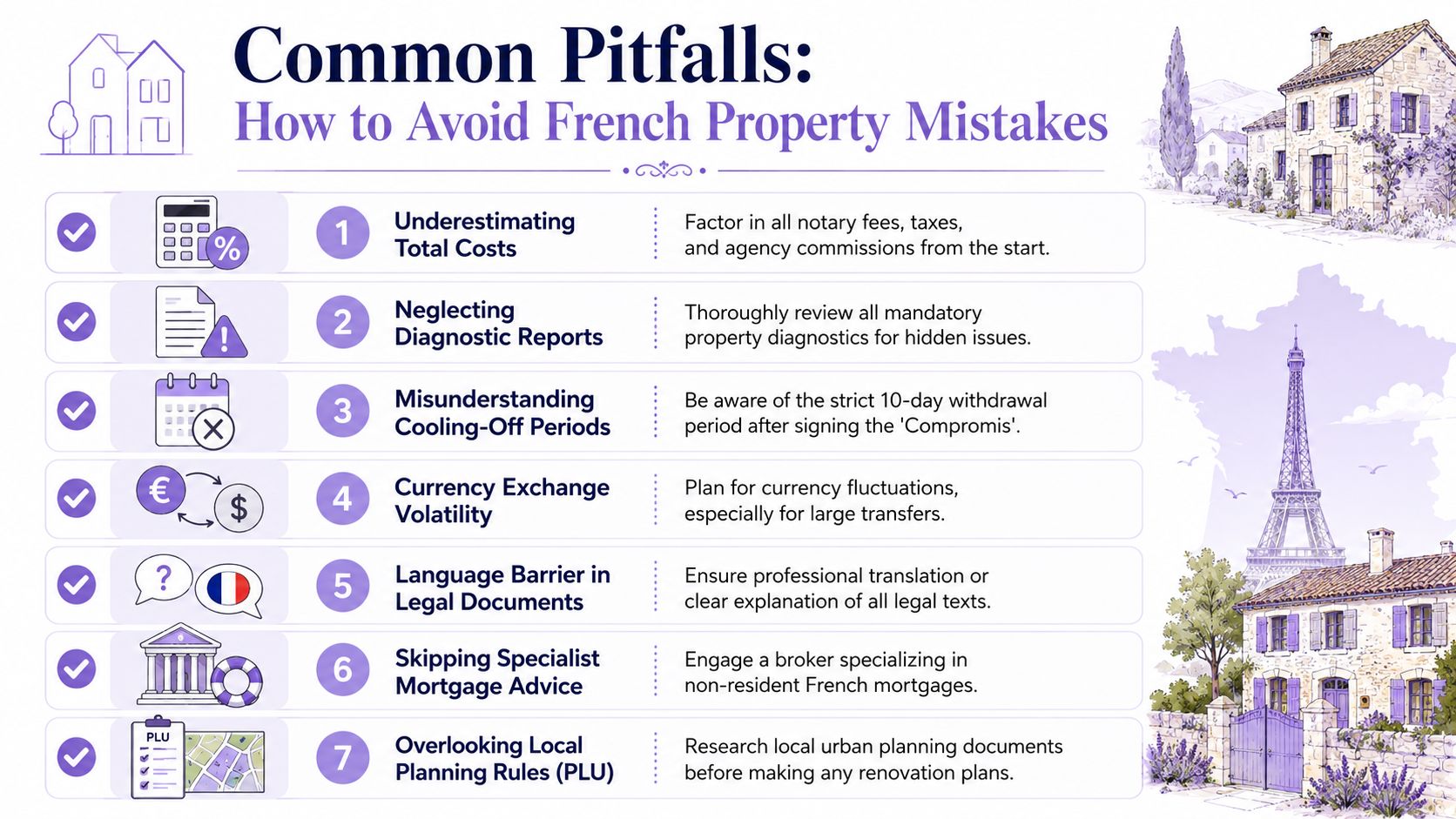
Transactions rarely go wrong because of one dramatic event. They go wrong because several manageable issues are left to drift at the same time. A mortgage file starts late. Supporting documents arrive in mixed formats or the wrong language. Funds are available, but not in a way the bank or notaire can verify quickly. For expat buyers, that combination causes more trouble than the legal process itself.
The safest approach is to treat financing, document collection, and property checks as parallel workstreams. If you wait for one stage to finish before starting the next, the file often loses momentum. Sellers get nervous. Deadlines tighten. Buyers feel pushed into decisions they would handle better with two extra weeks and a clearer plan.
The mistakes I see most often
Falling in love with the property before testing mortgage eligibility: French banks do not assess foreign income the way your home bank does. Bonuses, dividends, self-employed earnings, and multiple currencies all need careful presentation.
Treating diagnostics as the end of due diligence: The diagnostic pack is useful, but it does not replace proper scrutiny of condition, building issues, planned works, or co-ownership risks.
Underestimating paperwork friction: Non-resident files often involve tax returns, company accounts, payslips, bank statements, ID, proof of address, and source-of-funds evidence from different countries. If those documents are inconsistent, the lender notices.
Leaving source of funds too vague: A deposit funded by savings, asset sales, family support, or business distributions can be acceptable, but it must be documented clearly and early.
Choosing advisers who do not handle expat files regularly: A standard local process can break down fast when income, residency, and banking span more than one jurisdiction.
Negotiating hard before looking finance-ready: In France, sellers and agents respond well to buyers who look credible, organized, and capable of reaching completion without drama.
One point matters more than buyers expect. A good mortgage decision in principle is not the same as a bankable file in practice. I see this often with high-earning clients whose finances are perfectly sound but hard to read on paper. The issue is not affordability alone. It is whether the lender can interpret the income quickly, document it properly, and fit it inside its own credit policy.
What a smoother purchase looks like
Strong buyers prepare the bank file before the property search becomes urgent. They know how their income will be presented. They keep deposits traceable. They ask early whether translations, certified copies, or extra tax evidence will be needed. They also raise ownership and family questions before signing documents, not after.
That preparation changes the tone of the whole transaction. The notaire gets clean paperwork. The lender gets a coherent file. The agent sees a buyer who can perform. You reduce the risk of last-minute renegotiation, funding delays, or legal scrambling.
For a concise checklist of recurring errors, Invexa's tips for French property investment gives a useful overview of where non-resident purchases often stall.
In France, the calmer buyer usually wins. Calm comes from preparation, not luck.
Frequently Asked Questions for Expat Buyers
Do I need a French bank account?
Sometimes yes in practice, even when not strictly required at the very beginning. Much depends on the notaire, the lender, and how funds will move. If you're financing in France, expect banking logistics to become part of the process. Don't leave this to the last minute.
Has Brexit changed the buying process for UK buyers?
UK buyers can still purchase property in France. The main change is usually around residency, time spent in France, and administrative planning, not the basic right to buy. The property process itself remains workable, but supporting paperwork and longer-stay plans need more care.
Is buying new-build different from buying an older property?
Yes. Costs and timelines can differ, and the practical questions are not the same. Existing homes often raise more diligence issues around condition and diagnostics. New-build purchases can be cleaner in some respects, but the contract package and delivery timing need close review.
We're relocating with animals. Anything to prepare early?
Yes. If your move includes pets, prepare travel logistics well before completion so property timing and relocation timing don't clash. This pet travel US to France resource is a practical starting point for buyers organizing both a purchase and an international move.
If you want help turning a non-resident project into a financeable French purchase, Invexa works specifically on expatriate and overseas-buyer mortgage files, including foreign income analysis, bank presentation, borrower insurance, and remote support through to notary signing.